10 Best Flatbed Truck Manufacturers Worldwide?
Choosing the right flatbed truck manufacturer affects payload capacity, operating costs, uptime, and driver confidence. This guide examines ten leading manufacturers serving markets across North America, Europe, Asia, and other regions. It considers more than brand recognition.
The evaluation focuses on chassis strength, deck design, corrosion resistance, suspension options, safety systems, fuel efficiency, and factory support. It also reviews customization for construction materials, machinery, agricultural loads, and general freight. A dependable manufacturer should provide clear specifications, accessible parts, trained service centers, and practical warranty coverage. Those details matter when a loaded truck is working far from a major city.
Real-world performance can differ. Road conditions, climate, maintenance habits, and local regulations influence every result. No ranking is flawless. Some manufacturers excel at heavy-duty durability, while others offer better technology, lower ownership costs, or stronger regional support. Buyers should verify axle ratings, body dimensions, tie-down points, and legal weight limits before ordering. A polished brochure cannot replace a careful inspection.
This comparison uses manufacturer information, industry expertise, fleet considerations, and publicly available performance evidence. It aims to help fleet managers, contractors, and independent operators make a more informed decision. The best flatbed truck is not always the most powerful or expensive model. It should match the work, the route, and the available service network. Practical fit matters most.
What Is a Flatbed Truck and Where Is It Used?
What Is a Flatbed Truck and Where Is It Used?
A flatbed truck has a level, open platform without fixed sides or a roof. This design allows forklifts and cranes to load cargo from several directions. It commonly carries steel beams, timber, concrete panels, agricultural equipment, and industrial machinery. Oversized cargo also benefits from the platform’s open dimensions. According to the American Trucking Associations’ 2024 report, trucks moved 72.6% of U.S. freight by weight in 2022. That figure shows why adaptable equipment matters across construction, manufacturing, energy, and farming.
A reliable flatbed setup needs a strong deck, suitable axle capacity, and secure tie-down points. The Federal Motor Carrier Safety Administration requires cargo securement systems to withstand specified forces during transport. In practice, operators must check edge protection, chains, straps, tarps, and load balance before departure. A common mistake is choosing capacity by weight alone. Cargo length, center of gravity, weather exposure, and loading access can matter just as much. No single configuration fits every route.
Tips: Match deck length to the cargo, not the sales brochure. Keep heavy items low and centered. Inspect straps for cuts and damaged hooks. Leave space for safe crane access. The FHWA Freight Analysis Framework projects major growth in U.S. freight activity through 2050, so flexible flatbeds may remain valuable. Still, equipment selection deserves review after real delivery experience.
10 Best Flatbed Truck Manufacturers Worldwide? - What Is a Flatbed Truck and Where Is It Used?
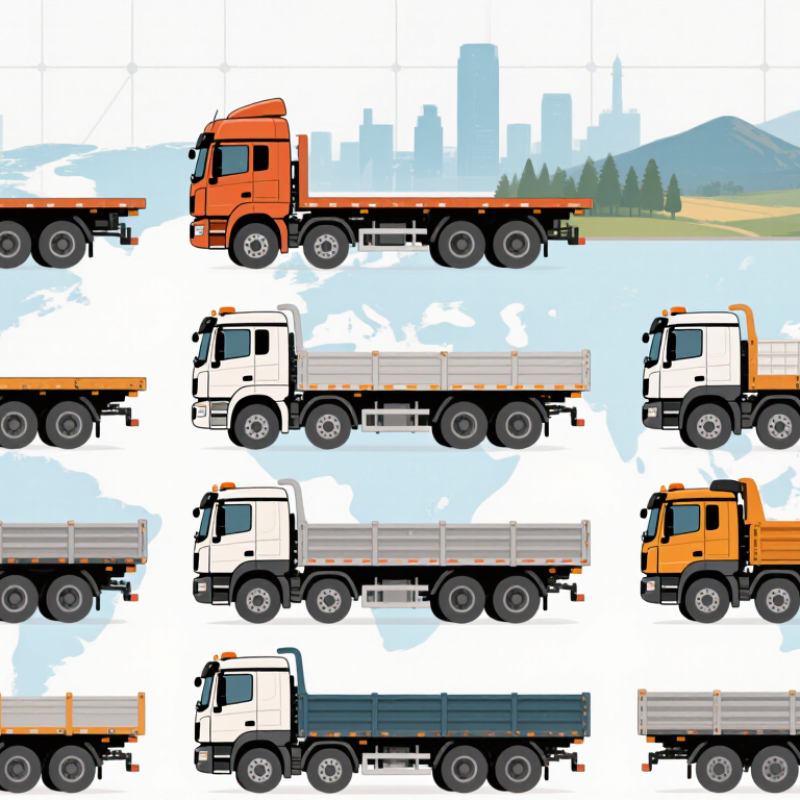
Manufacturer-neutral overview of widely used flatbed truck configurations and their typical operating characteristics.
| No. |
Flatbed Configuration |
Typical GVW Class |
Typical Payload |
Usable Deck Length |
Common Drive Layout |
Typical Applications |
Key Selection Factor |
| 1 |
Light-Duty Pickup Flatbed |
3.0–4.5 t |
0.75–1.8 t |
2.4–3.7 m |
4×2 or 4×4 |
Landscaping, farm deliveries, maintenance work and small construction loads |
Payload rating and rear-axle capacity |
| 2 |
Medium-Duty Rigid Flatbed |
6–12 t |
3–7 t |
4.5–7.0 m |
4×2 or 4×4 |
Building materials, machinery transport and regional distribution |
Wheelbase, maneuverability and body payload |
| 3 |
Heavy-Duty Rigid Flatbed |
16–26 t |
8–16 t |
6.0–9.0 m |
4×2, 6×2 or 6×4 |
Steel products, precast components, heavy equipment and infrastructure work |
Axle loading, frame strength and tie-down points |
| 4 |
All-Wheel-Drive Off-Road Flatbed |
7.5–18 t |
3–10 t |
4.0–7.5 m |
4×4, 6×6 or 8×8 |
Mining, forestry, remote construction and disaster-response logistics |
Ground clearance, traction and approach angle |
| 5 |
Crane-Equipped Flatbed |
7.5–32 t |
2–18 t |
4.0–8.5 m |
4×2, 6×2 or 6×4 |
Utility installation, construction sites, equipment placement and material handling |
Crane lifting moment and remaining payload |
| 6 |
Drop-Side Flatbed |
6–26 t |
3–16 t |
4.5–9.0 m |
4×2, 6×2 or 6×4 |
Palletized freight, bagged materials and loads requiring side access |
Side-wall height, loading access and cargo containment |
| 7 |
Low-Profile Machinery Flatbed |
18–32 t |
10–24 t |
7.0–12.0 m |
6×2, 6×4 or tractor-trailer |
Excavators, loaders, generators and industrial machinery |
Deck height, ramp design and concentrated-load capacity |
| 8 |
Standard Flatbed Semi-Trailer |
34–40 t combination |
20–30 t |
12.0–13.7 m |
Tractor with 6×2 or 6×4 configuration |
Long-distance transport of steel, lumber, concrete products and machinery |
Legal gross combination weight and load-securing equipment |
| 9 |
Extendable Flatbed Trailer |
34–40 t combination |
18–30 t |
13.7–30.0 m extended |
Tractor with 6×2 or 6×4 configuration |
Wind-turbine sections, bridge beams, pipes and other long cargo |
Axle spacing, turning radius and route permits |
| 10 |
Multi-Axle Heavy-Haul Platform |
Above 40 t combination |
30–100+ t, subject to permits |
10–25+ m |
6×4, 8×4 or modular axle lines |
Transformers, industrial vessels, bridge sections and oversized structures |
Axle-line capacity, permits, route engineering and braking performance |
Note: Payload, gross vehicle weight and dimensions vary by jurisdiction, chassis specification, axle configuration, body materials and local road regulations. Always verify the certified rating and applicable legal limits before operation.
Key Criteria for Evaluating Flatbed Truck Manufacturers
Evaluating flatbed truck manufacturers requires more than comparing prices. Start with payload engineering. Check axle ratings, deck strength, tie-down points, suspension design, and corrosion protection. A stronger frame can reduce downtime, but excessive weight may reduce legal payload. This trade-off deserves careful measurement.
ATRI’s 2024 Operational Costs report placed average trucking costs near $2.26 per mile in 2023. That figure makes fuel efficiency, maintenance access, and resale value important evaluation criteria. Review warranty terms, parts availability, technician coverage, and repair response times. A low purchase price can become expensive when a trailer-side component delays a delivery. IRU’s 2024 driver shortage report also projected a potential global shortage of 3.6 million professional drivers by 2028. Therefore, cab comfort, visibility, loading ergonomics, and simple controls matter. They affect recruitment and daily productivity.
Tips: Request a documented payload test, not only a brochure figure. Inspect weld quality, deck drainage, lighting, and hydraulic fittings. Ask for three-year maintenance records from comparable fleets. Use a weighted scorecard covering safety, uptime, operating cost, and support. No scorecard is perfect. Regional roads, climate, and cargo types can change the result. I would also question unusually optimistic efficiency claims unless independent data supports them.
Key Criteria for Evaluating Flatbed Truck Manufacturers
This chart presents a practical procurement weighting for comparing flatbed truck manufacturers worldwide. Payload and chassis durability receive the highest priority, while safety compliance, after-sales support, operating efficiency, customization, and total cost of ownership are also essential when building a manufacturer shortlist.
The 10 Best Flatbed Truck Manufacturers Worldwide
The 10 Best Flatbed Truck Manufacturers Worldwide are judged by more than production volume. Field experience shows that dependable builders balance payload capacity, chassis strength, and long-term service access. Their trucks often use reinforced frames, corrosion-resistant flooring, and carefully positioned tie-down points. Small details matter. A flatbed that loads easily can save minutes on every delivery.
The strongest manufacturers serve different working conditions. Some specialize in compact urban vehicles, while others build heavy-duty platforms for construction and agriculture. The best designs provide clear axle ratings, stable suspension systems, and practical hydraulic options. They also publish accurate maintenance schedules and supply replacement parts through established networks. That reliability supports operators in remote regions. Still, no ranking is perfect. A truck successful in dry climates may perform differently in coastal weather or freezing temperatures. Buyers should inspect weld quality, deck height, lighting, and load restraint compatibility before choosing. A low purchase price can hide expensive downtime. Manufacturers that collect operator feedback often improve their designs faster, although not every update solves every problem. Real performance depends on matching the vehicle to its route, cargo, road surface, and maintenance discipline.
How to Choose the Right Flatbed Truck Manufacturer
10 Best Flatbed Truck Manufacturers Worldwide?
How to Choose the Right Flatbed Truck Manufacturer
Choosing a flatbed truck manufacturer requires more than comparing prices. Start with the truck’s intended work. Construction materials, agricultural equipment, and regional deliveries create different demands. A suitable manufacturer should provide clear payload ratings, axle specifications, deck dimensions, and braking details.
Look beyond brochures. Inspect the welding quality, frame thickness, deck coating, and tie-down points. During practical fleet assessments, small details often reveal long-term reliability. Ask for load-test records and maintenance schedules. Request references from operators with similar routes and cargo. Their experience may expose weaknesses that technical documents hide.
Service matters. Confirm parts availability, technician training, warranty terms, and expected repair times in your operating region. A low purchase price can become expensive when a truck waits weeks for a simple component. Review production lead times carefully, especially for customized decks or reinforced frames. Check whether the manufacturer follows applicable safety and road standards.
I would not select a supplier from specifications alone. Factory audits, sample inspections, and written agreements reduce uncertainty. Still, no evaluation is perfect. I once underestimated downtime caused by poor hydraulic access. That mistake changed how I compare designs. The best choice balances strength, service support, lifecycle cost, and honest communication.